Most Financial Advisors Are Not Money Managers.
They are capital allocators. They assign your money to a risk profile — conservative, moderate, aggressive — and then they hold it there. The allocation is set at the beginning of the relationship and rarely changes in any meaningful way, regardless of what the market is doing.
This is not a criticism of their character. It is a description of their model. The traditional advisory model was not designed to actively manage capital. It was designed to allocate it — once — and then maintain that allocation through periodic rebalancing.
That is why you hear the same phrases from every advisor, at every firm, in every market environment:
You have heard these before.
- "It will come back."Said during every decline. True often enough that it sounds like strategy. It is not.
- "Stay the course."The most common phrase in the industry. It means: we are not going to do anything differently.
- "Think long-term."Correct advice. Also the default response when there is no active strategy to discuss.
- "This is normal volatility."Sometimes true. Always said. Never followed by a description of what changes as a result.
These phrases are not wrong. They are incomplete. They are the language of a model that has no mechanism for responding to what the market is actually doing — so it responds with reassurance instead.
The Problem Is Not Just Downside. It Is Also Upside.
Most investors understand the risk of losing money. What they rarely consider is the equal and opposite risk: not participating enough when the market is rising.
If your portfolio gained 12% in a year when the market gained 20%, you did not break even on the difference. You lost it — permanently. The compounding that would have followed those missing 8 points does not arrive later. It does not average out over time. It is gone, and the growth that would have built on it is gone with it.
The same is true in reverse. A portfolio that stays fully invested during a sustained decline does not just lose money — it loses the time required to recover it. And in retirement, time is the one resource that cannot be replaced.
- —Capital role is fixed at the start
- —No mechanism to lean into leadership
- —No mechanism to reduce exposure to laggards
- —Reassurance replaces active management
- —Both directions of inefficiency compound quietly
- ✓Capital role adjusts based on conditions
- ✓Leans into growth when markets support it
- ✓Steps back when conditions deteriorate
- ✓Process governs decisions — not reassurance
- ✓Inefficiency in both directions is the target
A static allocation is not conservative. It is indifferent — indifferent to whether capital is being used productively, indifferent to whether the environment rewards growth or demands protection. Indifference is not a strategy. It is the absence of one.
We Do Not Assign Capital and Wait. We Manage It.
Rulicent is a rules-based wealth management firm. That means capital allocation, risk exposure, and strategy adjustments are governed by a defined process — not a risk questionnaire completed at the beginning of the relationship and never revisited.
The process monitors which sectors of the market are leading and which are lagging — and adjusts accordingly. When conditions favor growth, capital leans into it. When conditions deteriorate, exposure is reduced. The process runs on rules. It does not predict. It observes what is already happening and responds.
This is not a description of a philosophy. It is a description of a mechanism — one that can be explained, evaluated, and held accountable. You will not hear “stay the course” from Rulicent. You will hear what the process is doing and why.
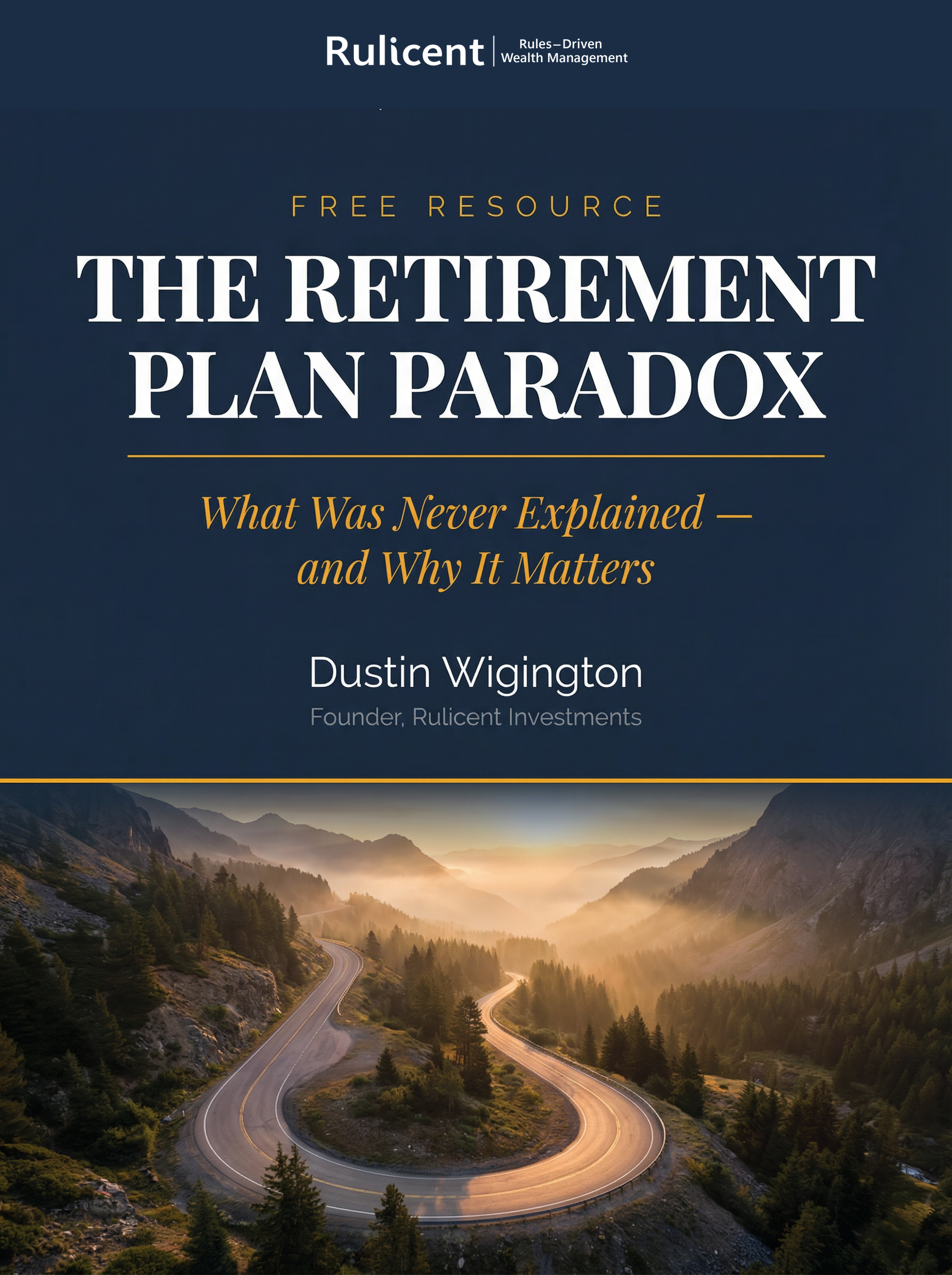
The Retirement Plan Paradox was written to explain this framework in full — the structural problems with the traditional model, and what a portfolio built to actually manage capital looks like.
Your Portfolio Owns Everything. That Is Exactly the Problem.
At any given time, only a small number of sectors drive most of the market's returns. The rest lag — sometimes for months, sometimes for years. A style-based portfolio owns both simultaneously, by design.
This means most of your portfolio is permanently assigned to parts of the market that are not doing the work. Not occasionally. Persistently. Capital that could be leaning into leadership is instead funding laggards — because the structure was never built to tell the difference.
This is not a flaw in execution. It is the inevitable result of a structure that was never designed to adapt. The portfolio does not fail dramatically. It fails through the quiet, compounding arithmetic of inefficiency — small gaps that persist, underperformance that compounds, and a plan that quietly tightens without ever triggering an alarm.
A pattern we see repeatedly.
An investor comes in with a portfolio described as “diversified income” — dividends, stability, real assets. It held real estate funds, energy, utilities, and consumer staples. On the surface, it looked thoughtfully constructed.
What the portfolio had almost none of: the sectors that had been driving most of the market’s returns for years. Technology, consumer discretionary, communication services — structurally absent.
The investor had never asked to abandon growth. They had simply trusted that “diversified” meant balanced participation. It did not. The underperformance was not the result of bad timing or poor judgment. It was structural — and once that structure was visible, the years of stagnation made complete sense.
A portfolio can feel diversified and still be structurally concentrated in the wrong places. Without seeing exposure at the sector level, there is no way to know the difference. This is one of the core frameworks The Retirement Plan Paradox was written to explain.
Are You Looking for OK or Great? The Difference Is Immense.
Whether you are choosing an advisor or already working with one — this question changes everything.
Most people approach this decision the way they approach everything else — by trying harder. More meetings. More research. More time. The problem is that without a framework, more information doesn't produce more clarity. It produces more confusion.
You didn't accept OK in your career. You didn't build what you've built by settling for good enough. But without a framework to evaluate financial advisors, most people unknowingly do exactly that — not because they stopped caring, but because they had no way to tell the difference.
OK and great can sit in the same room, use the same language, and hand you the same brochure. Without the right questions, you cannot tell them apart. The gap isn't visible in the first meeting. It shows up years later — in a retirement that holds, or one that quietly doesn't.
Can you really afford to interview advisors without knowing what to look for?
The Retirement Plan Paradox gives you the framework to change that — before it's too late.
The Retirement Plan Paradox gives you the framework to tell the difference before it matters. This is the shortcut — not to skipping the decision, but to making it with clarity instead of guesswork.
Every Person We've Spoken With Has Said Some Version of the Same Thing.
"I built an entire career on knowing what I was doing. I have no idea how to evaluate this."
The people who say this are not easily rattled. They are not inexperienced. They are accomplished, careful, and used to making good decisions. And yet, when it comes to evaluating a financial advisor — they say the same thing. Not a reflection of intelligence. A reflection of a gap that was never filled.
Sound familiar?
- ✓Every advisor sounds exactly the same.
- ✓You don't know what questions to ask.
- ✓The credentials don't tell you what you need to know.
- ✓The stakes feel too high to guess.
- ✓You feel like you're supposed to already know this.
- ✓The responsibility has kept you from moving forward.
You were handed answers. Nobody taught you the questions. That is the gap The Retirement Plan Paradox Bundle was written to close.
You could spend years trying to figure this out. Get the Framework you need instantly.
There is no shortcut to building a great retirement. But there is a shortcut to being equipped to make the most important decision that stands between you and one.
You could spend years trying to get to the clarity this book delivers in a single read. Meetings that go nowhere. Research that raises more questions than it answers. Conversations that feel productive and leave you exactly where you started.
That's not a failure of effort. That's what happens when you're trying to solve a problem without the framework to solve it. The Retirement Plan Paradox is that framework.
- ✕Every advisor sounds the same
- ✕No framework to evaluate credentials
- ✕Meetings that go nowhere
- ✕Paralysis from not knowing what to ask
- ✕Decisions made on confidence, not clarity
- ✓You know exactly what to ask
- ✓You can evaluate any advisor's structure
- ✓You understand what a real plan looks like
- ✓You know the red flags before they cost you
- ✓You make the decision with confidence
What You're Getting — And Why Each One Matters
Most investors approach the advisor decision with no tools, no framework, and no way to evaluate what they're hearing. This bundle changes that — completely.
The Retirement Plan Paradox
The framework the industry never gives you. Why most retirement plans are built wrong, what the standard advice gets backwards, and how to evaluate any advisor before you trust them with your retirement. This is the foundation everything else builds on.
The 30 Questions to Ask Any Advisor
Most advisor meetings end with the prospect still not knowing if they're talking to the right person. These are the questions that change that — the ones that reveal whether an advisor is actively managing your portfolio or simply holding it. Bring this to every meeting. You'll know within the first ten minutes.
Red Flags in Your Portfolio
You don't need to wait for a meeting to know if something is wrong. This checklist walks you through the structural warning signs most investors never notice — until a down market makes them impossible to ignore. Fifteen minutes. Plain language. You'll know where you stand.
The Two-Engine Framework
The single most important concept in retirement portfolio construction — explained in one page, without jargon. Growth when markets support it. Protection when they don't. If your current portfolio doesn't work this way, this is the conversation you need to have.
Get The Retirement Plan Paradox — Free
207 pages. 35 chapters. Plus 3 companion resources. Instant download.
Most Firms Protect This Information. We're Handing It to You Deliberately.
There is a reason most financial firms don't publish a framework for evaluating financial advisors.
An investor who knows exactly what to look for, exactly what questions to ask, and exactly what a qualified answer sounds like — is harder to impress with a polished pitch. Informed investors aren't easily moved by confident language and a nice office. But most importantly, uninformed investors don't ask tough questions.
Opacity is a business strategy. Most of the industry depends on it.
We're doing the opposite.
We want you to have every question in this book — every red flag, every framework, every distinction — so that you can ask the questions that actually matter.
Our goal is to educate people and give them the best possible chance to achieve their retirement goals. That starts with being an informed investor. It then becomes the advisor's job to articulate structure, explain strategy, and ensure you understand how risk is being managed.
That confidence doesn't come from a marketing strategy. It comes from over 1,000 client meetings. From watching intelligent, accomplished people struggle not because they weren't trying — but because nobody had ever given them the framework to evaluate what they were hearing.
You are not wrong to trust the financial services industry. You are wrong to assume the system it created was built to manage retirement risk.
Rulicent is a fee-only fiduciary wealth management firm based in Oklahoma City. We work with investors approaching or in retirement who want a defined, transparent investment process — not a packaged model portfolio managed by someone they've never met.
Fee-only means we do not earn commissions. We do not sell products. We do not have a financial incentive to recommend one strategy over another. Our only incentive is your outcome.
Fiduciary means we are required to act in your best interest — not just in some contexts, not just for some recommendations. Every decision. Every time.
Capital allocation, risk exposure, and strategy adjustments are governed by a defined process — not judgment calls, not static models, not market narratives. The process runs. The emotion doesn't.
Your Statement Looked Fine. That Is Not the Same as Working.
A portfolio that earns 5% feels successful — until you know the market delivered significantly more during the same period.
Without a benchmark tied to how the market actually behaved, that gap remains invisible. The account went up. The statement looked fine. But missed participation compounds. Future required returns rise. Flexibility shrinks. The plan that looked comfortable at 65 becomes strained at 72 — not because anything went wrong, but because the quiet arithmetic of underperformance had been running in the background for years.
This is why most investors do not discover the problem until it is too late to correct it. Not because they were not paying attention. Because no one gave them a framework for knowing what to look for.
What Rulicent measures — and why it matters.
Every retirement plan is built on assumptions about spending, longevity, inflation, and required return. Those assumptions create an implied benchmark — whether it is acknowledged or not. If your plan requires a certain rate of return to work, your portfolio must be capable of keeping pace with a market environment that can realistically deliver it.
At Rulicent, we measure against that benchmark continuously — not to compete, but to detect drift before it becomes a problem. Because drift does not announce itself. It accumulates quietly. And the time to address it is before the plan tightens, not after.
A few things worth knowing before you download.
Get the Free Retirement Plan Paradox Book
207 pages. 35 chapters. Plus 3 companion resources. A complete framework for retirement investors who want to understand what most plans get wrong — and why. Plain language. No obligation.
Instant access. No obligation, ever.
Want to learn more about us first? Visit rulicent.com →