Whether you are choosing an advisor or already working with one — this distinction changes everything.
Most people who already have an advisor have never asked this question. They assumed the relationship answered it. It does not. The fiduciary label tells you how an advisor is required to communicate with you. It says nothing about whether they are actively managing your money, adjusting your exposure, or responding to what the market is actually doing.
An advisor can disclose that they use model portfolios, rebalance periodically, and follow a long-term allocation — and be fully compliant with their fiduciary duty — even if that approach never adapts to changing market conditions. The relationship feels active. The strategy itself may not be. This toolkit gives you the framework to find out — before you hire anyone, or right now.
Paid exclusively by you.
Paid by you — and by commissions.
"Most retirees do not realize that no one is adjusting their exposure, no one is managing risk in response to what is actually happening. They believe these things are happening because the relationship feels active. The strategy itself is not."
— The Retirement Plan Paradox, Chapter 17: The Fiduciary Fallacy, by Dustin Wigington
The fiduciary label tells you how an advisor is required to communicate with you. It says nothing about whether they have a defined investment process, whether they actively manage risk, or whether their strategy adapts as market conditions change. That is the gap this toolkit was built to close.
Five resources. One complete framework.
Most people spend years trying to figure out who to trust with their retirement — and still aren't sure. This toolkit gives you everything you need to evaluate any advisor, whether you're choosing one for the first time or assessing the one you already have.
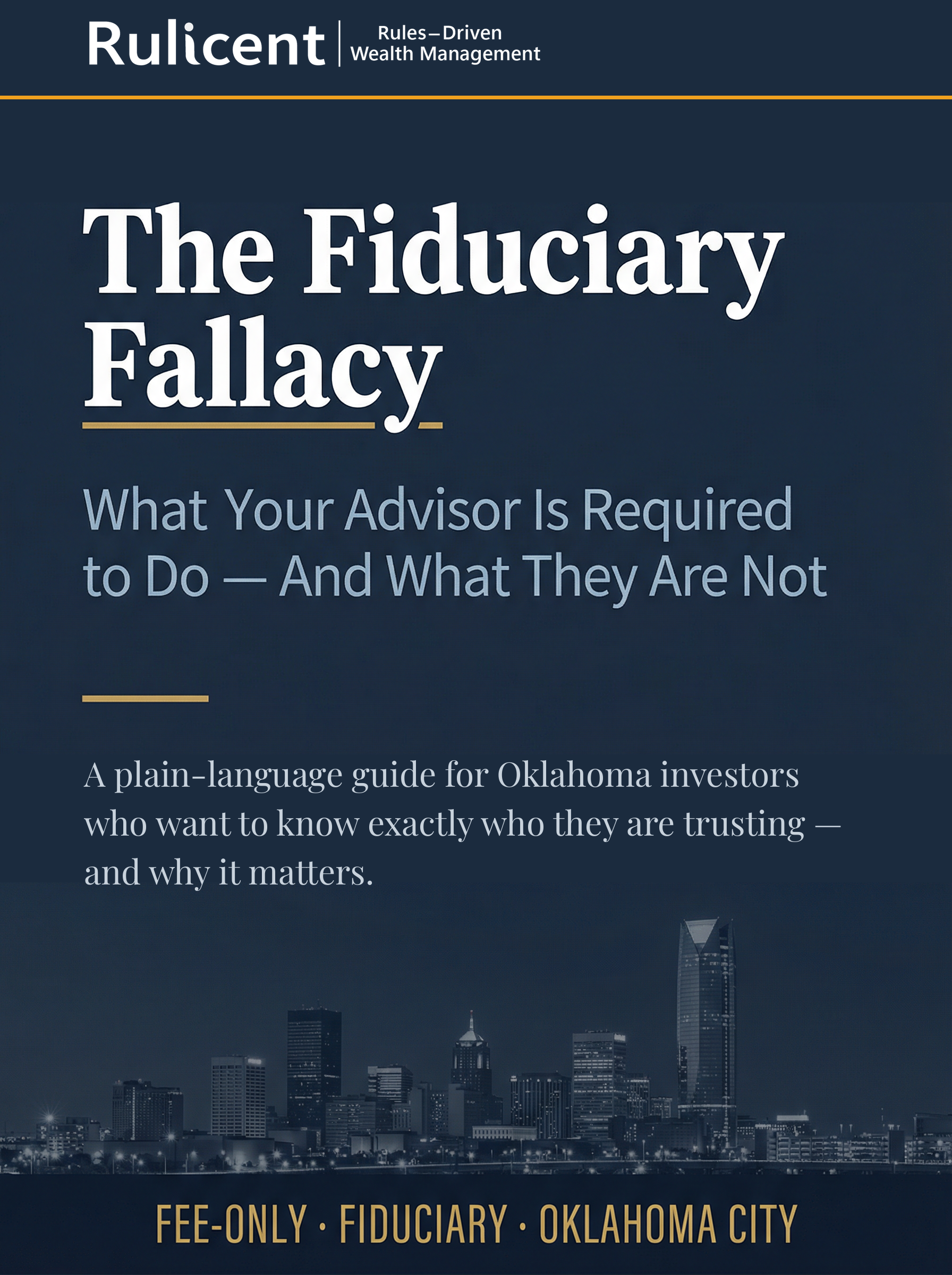
The Fiduciary Fallacy — Plain-Language Guide
You searched for a fiduciary. This guide explains what that actually means — legally, practically, and in terms of what it does and does not guarantee. What fiduciary requires, what it doesn't, the difference between fee-only and fee-based, and the specific questions that reveal which standard your advisor actually operates under.
The Retirement Plan Paradox — 207 Pages · 35 Chapters
The framework the industry never gives you. Why most retirement plans are built wrong, what the standard advice gets backwards, and how to evaluate any advisor before you trust them with your retirement. The fiduciary guide tells you what the label means. This book tells you what to look for beyond it.
30 Questions to Ask Any Advisor — 1-Page Guide
Most advisor meetings end with the prospect still not knowing if they're talking to the right person. These are the questions that change that — the ones that reveal whether an advisor is actively managing your portfolio or simply holding it. Bring this to every meeting. You'll know within the first ten minutes.
Red Flags in Your Portfolio — Self-Assessment Checklist
You don't need to wait for a meeting to know if something is wrong. This checklist walks you through the structural warning signs most investors never notice — until a down market makes them impossible to ignore. Fifteen minutes. Plain language. You'll know where you stand.
The Two-Engine Framework — 1-Page Visual Model
The single most important concept in retirement portfolio construction — explained in one page, without jargon. Growth when markets support it. Protection when they don't. If your current portfolio doesn't work this way, this is the conversation you need to have.
Get the Complete Evaluation Toolkit
Instant access. No obligation, ever.
There is a reason most financial firms don't publish a framework for evaluating financial advisors.
An investor who knows exactly what to look for, exactly what questions to ask, and exactly what a qualified answer sounds like — is harder to impress with a polished pitch. Informed investors aren't easily moved by confident language and a nice office. But most importantly, uninformed investors don't ask tough questions.
Opacity is a business strategy. Most of the industry depends on it. We're doing the opposite.
We want you to have every question in this toolkit — every red flag, every framework, every distinction — so that you can ask the questions that actually matter. That starts with being an informed investor. It then becomes the advisor's job to articulate structure, explain strategy, and ensure you understand how risk is being managed.
That confidence doesn't come from a marketing strategy. It comes from over 1,000 client meetings — from watching intelligent, accomplished people struggle not because they weren't trying, but because nobody had ever given them the framework to evaluate what they were hearing.
"You are not wrong to trust the financial services industry. You are wrong to assume the system it created was built to manage retirement risk."
Rulicent is a fee-only fiduciary wealth management firm based in Oklahoma City. We do not earn commissions. We do not sell products. We are paid exclusively by our clients — which means our only incentive is to manage your money well.
Our investment strategy is governed by SectorPulse™ — a rules-based process that determines how capital is allocated and how risk is managed across market cycles. Capital allocation, risk exposure, and strategy adjustments are governed by a defined process — not judgment calls, not static models, not market narratives. The process runs. The emotion doesn't.
A few things worth knowing before you download.
Get the Complete Evaluation Toolkit — Free
Five resources. One complete framework. From understanding what fiduciary actually means to evaluating whether any advisor is qualified to manage your retirement.
Instant access. No obligation, ever.
Want to learn more about us first? Visit rulicent.com →
Already working with an advisor? Use the same framework to evaluate them →